
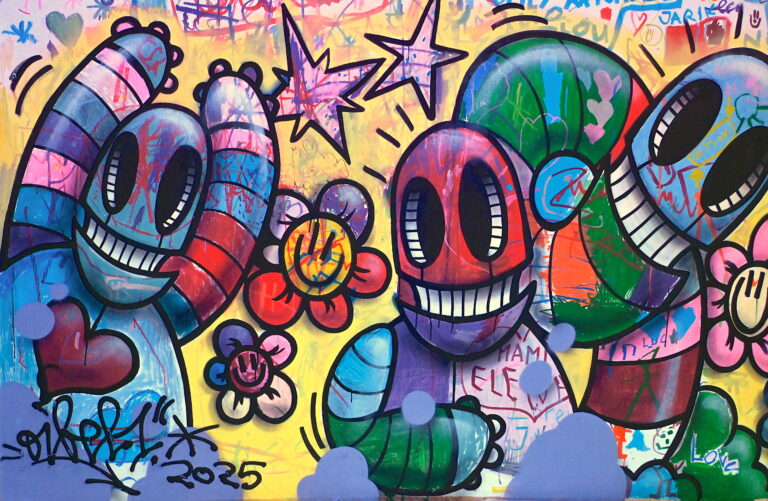
By Samora “Oibel1” Bazarrabusa
One of the biggest misconceptions I encounter is the idea that creativity belongs to artists.
Whenever people find out that I’m an artist, they often tell me:
“I’m not creative.”
I never quite know what to say to that because I’ve never met a human being who wasn’t creative.
The more I observe life, the less I see creativity as something artistic and the more I see it as something fundamentally human.
The older I get, the more I believe that creativity is not something reserved for painters, musicians, writers, or designers.
Creativity is part of being alive.
Creativity Belongs to Everyone
Every solution requires creativity.
Every decision requires creativity.
Every day requires creativity.
A parent coordinating work, family life, school schedules, sports practice, grocery shopping, friendships, and everything else that comes with raising children is being creative all day long.
A business owner navigating uncertainty is creative.
A teacher finding a new way to reach a student is creative.
A person rebuilding their life after a difficult period is creative.
Most of these things will never hang on a gallery wall, but they are creative acts nonetheless.
Perhaps the confusion comes from the fact that we often associate creativity with artistic expression.
I see it differently.
To me, creativity is our ability to respond to life.
Life constantly presents us with situations that have no instruction manual. We are forced to make decisions, adapt, improvise, and move forward with incomplete information.
That is creativity.
A Painting Is a Pile of Decisions
As an artist, I often tell children that when they look at a painting, they are actually looking at a pile of decisions.
People see the finished artwork.
What they don’t see are all the decisions that led to it.
Every line and color.
Every change of direction.
Every moment of uncertainty.
Every choice to continue.
The painting is simply the visible result of thousands of small decisions.
The more I think about it, the more I realize that life works the same way.
A life is also a pile of decisions.
Some large.
Most small.
One decision leads to the next.
The next creates another possibility.
That possibility creates another choice.
Over time, those decisions become a career, a relationship, a family, a business, a body of work, or a life.
Ideas Are the Easy Part
This is also why I believe people underestimate their own creativity.
Many people think creativity is having ideas.
I don’t.
Ideas are important, but ideas are the easy part.
The real challenge begins when an idea asks something of you.
An idea is exciting when it first arrives.
Then reality enters the conversation.
The idea suddenly requires effort.
Commitment.
Time.
Risk.
Patience.
Responsibility.
That’s often the moment where people let it go.
Not because the idea wasn’t good.
But because bringing an idea into reality can feel overwhelming.
I experience this myself all the time.
I still catch myself thinking:
“Why did I have this idea?”
Not because I don’t like the idea anymore, but because I suddenly understand the amount of work required to bring it to life.
The artwork, the exhibition, the project, the opportunity, the collaboration – none of them exist because of the idea alone.
They exist because somebody decided to follow through.
Creativity Requires Courage
There is another ingredient that rarely gets mentioned when people talk about creativity.
Courage.
Not because creativity is fearless, but because creativity requires us to move before we have all the answers.
Every meaningful idea eventually reaches a point where imagination is no longer enough.
The idea asks something of us.
It asks for action.
And most importantly, it asks us to proceed without knowing the outcome.
That is where courage enters the conversation.
Not the absence of fear, but the willingness to move despite it.
The willingness to make a decision without complete information.
The willingness to trust the process before the result is visible.
I don’t think creative people are necessarily less afraid than anyone else.
I think they become comfortable acting while uncertainty is still present.
The same is true for parents, entrepreneurs, teachers, leaders, and anyone trying to build something meaningful.
None of us know exactly how things will unfold.
We decide.
We act.
We observe.
We adapt.
And if things don’t work out as expected, we learn.
Failure is not the opposite of creativity.
Failure is one of creativity’s teachers.
Every outcome provides information.
Every setback reveals something we didn’t know before.
Every mistake becomes material for the next decision.
Perhaps that is why creativity and courage are so closely connected.
Both require us to step into the unknown and trust that we will find our way forward.
The Difference Between Having an Idea and Following It
People often look at something simple and say:
“Anybody could have done that.”
Maybe they’re right.
Maybe many people had a similar idea.
Maybe they saw it, considered it, and moved on.
Maybe they dismissed it as too simple, too obvious, too childish, or not important enough.
The question is not who had the idea.
The question is who acted on it.
Who trusted it enough to explore it.
Who was willing to put their name next to it.
Who was willing to go through the process of making it real.
Because having an idea and following an idea are two very different things.
One is a moment.
The other is a commitment.
One appears.
The other requires action.
The more I observe creativity, the less I see it as a gift given to a select few.
I see it as a constant invitation.
An invitation to respond.
To make a decision.
To solve a problem.
To follow a possibility.
To give form to something that previously existed only as a thought.
Creativity Belongs to Life
Creativity doesn’t belong to artists.
Artists simply dedicate their lives to one visible expression of it.
Creativity belongs to everyone.
More than that, I believe creativity belongs to life itself.
Because without creativity, nothing new could emerge.
Without creativity, there are no solutions.
No growth.
No adaptation.
No opportunities.
No art.
No movement.
No life.
And perhaps that is why creativity matters so much.
Not because it helps us make things.
But because it helps us become them.
Made from the heart for the soul.
— Samora “Oibel1” Bazarrabusa